


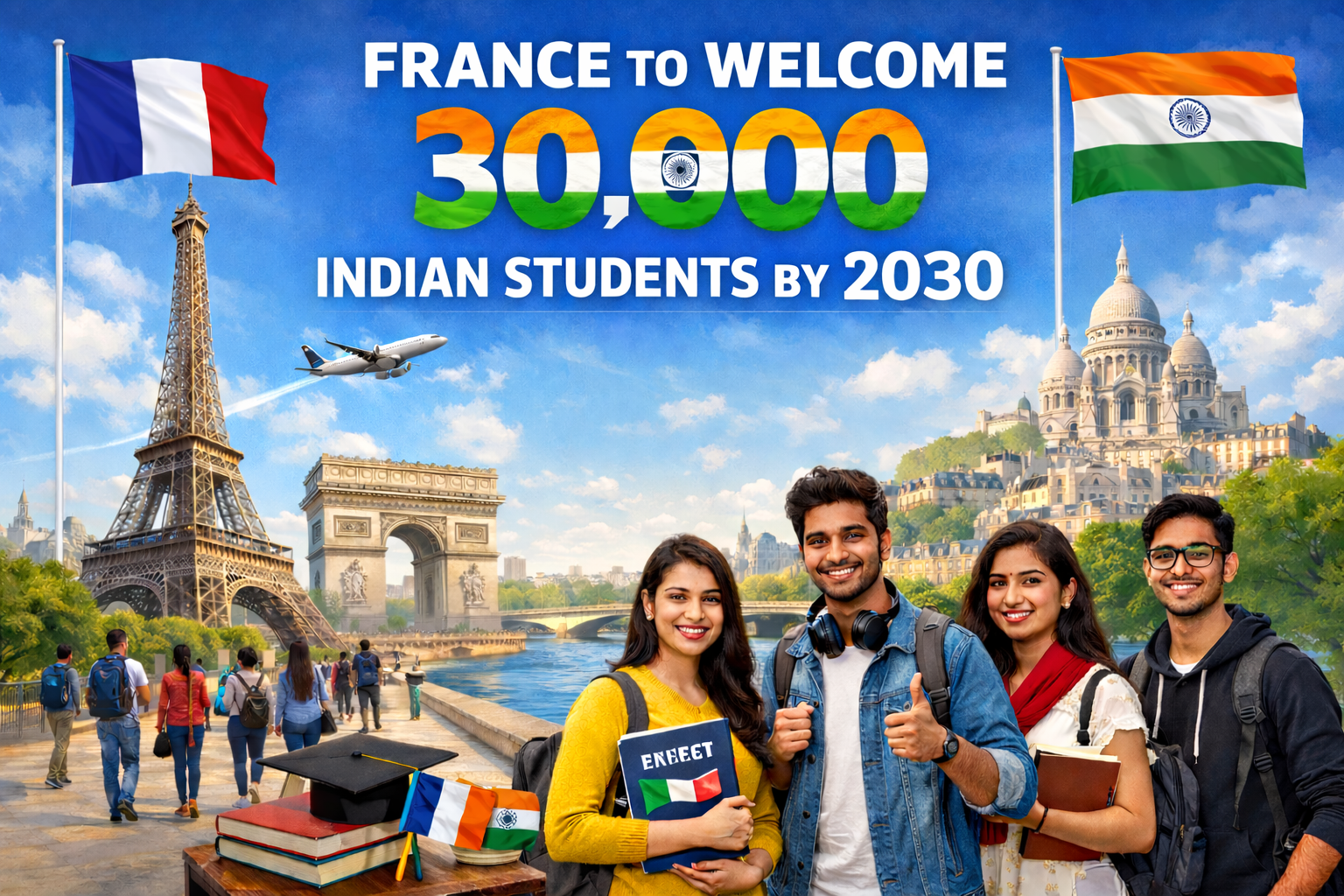
France Plans to Welcome 30,000 Indian Students by 2030
For many ambitious Indian students, the goal of studying abroad is not just about earning a degree; it’s about building a global career. Nearly 83% believe that a foreign degree can enhance their job prospects, while around 70% choose STEM programs. This preference is largely driven by a 97% focus on career-ready, job-oriented education. Together, these figures reflect a strong determination among Indian students to pursue international degrees, explore diverse destinations, and make strategic choices for their academic journeys.
However, despite this enthusiasm, the overall number of Indian students going abroad has declined over the past two years, falling from more than 9.08 lakh in 2023 to 6.26 lakh in 2025 (Rajya Sabha data -Times of India report). The journey is not without challenges. A weakening rupee, limited and traditional approaches to accessing education loans, stricter visa regulations, and rising tuition and living expenses have made studying abroad more complex and costly.
Additionally, growing uncertainty around post-study work opportunities has intensified concerns about return on investment. As a result, many students are delaying their decisions, exploring alternative destinations, or even reconsidering their study abroad plans altogether.
Against this backdrop, Emmanuel Macron’s recent visit to India from 17 to 19 February 2026, at the invitation of Narendra Modi, highlighted potential opportunities for students to explore degree opportunities in France.While much of the visit focused on diplomacy and innovation, a notable moment came at the All India Institute of Medical Sciences in New Delhi, where renewed emphasis was placed on strengthening academic ties with India, a country increasingly recognized as a global hub of talent. (Times of India)
The ‘Partnership for the People’ initiative, which focuses on student and professional mobility, may have flown under the radar, but the Horizon 2047 roadmap contains changes that could, over time, reshape how Indian students perceive France as a study destination.
Here’s what’s changing on the ground and why it matters for Indian students exploring opportunities abroad.
Bigger study abroad opportunities in France
France has publicly committed to hosting 30,000 Indian students by 2030.
(That’s almost three times the current number)
The target was first announced in 2023, shortly after Narendra Modi visited Paris as the chief guest at the country's Bastille Day. By reiterating it earlier this year, Emmanuel Macron made it clear that the initiative reflects a broader effort to attract young talent into France’s universities and research labs, foster multicultural campuses, and build long-term talent pipelines in sectors facing skill shortages.
And crucially, the capacity already exists.
Many public universities and grandes écoles are not operating at full enrollment, especially outside Paris—in cities like Clermont-Ferrand, Limoges, Le Mans, Besançon, Grenoble, and Nantes, across master’s programs in engineering, data science, management, and public policy.
Easier visas and travel
One of the most common anxieties heard from students considering France is visa uncertainty. Duration mismatches, repeated renewals, unclear timelines have long been sticking points.
During the visit, both sides emphasised simplifying student visa processes and aligning visa validity more closely with actual course length, including PhD programmes. When a visa covers the full duration of a degree with fewer renewals, everyday planning becomes simpler. Much simpler (Times of India report)
Here’s what it looks like in practice:
-
Signing longer rental leases (12- or 24-month) without worrying about a mid-year visa expiry
-
Committing to longer internships or research assistantships that run across semesters, instead of turning them down because a renewal is pending
-
Avoiding time spent on repeated applications and trips to prefectures or consulates, which often come with long waits
The two leaders also welcomed the introduction of a visa-free transit facility for Indian nationals at French airports. It is initially on a pilot basis, and is set to be reviewed after six months.
More courses in English
Traditionally, language was a barrier for Indian students considering French institutions. Eligibility often required clearing standardised French language tests such as the TCF (Test de connaissance du français) and the TEF (Test dâ Evaluation de français), even for academically strong candidates.
That’s changing.
Today, France offers over 1,700 English-taught programmes across its universities. That doesn’t make French irrelevant. Even learning basic phrases can make daily life easier, help you integrate culturally, and give you an advantage for internship and full-time roles in French-speaking environments.
So, do you have to build fluency in the language? No.
For students who want a European education without committing years upfront to language preparation, France has become more accessible, with room to grow once you’re already there.
New research and academic collaborations
Macron, alongside Union Health Minister J. P. Nadda, inaugurated an Indo-French Centre for AI in Health at All India Institute of Medical Sciences. The centre brings together leading institutions from both countries, including Sorbonne University, the Paris Brain Institute, and IIT Delhi.
For postgraduate and PhD researchers, this opens doors to working with leading international faculty and institutions, participating in joint projects, accessing cross-border funding, and engaging in collaborative innovation, particularly in areas like AI, healthcare, and technology. The Indo-French hub will create concrete spaces for exchanges, research partnerships, and the kind of hands-on experience that can shape a student’s academic and professional trajectory—internationally!
What this does not change
This visit does not make studying in France cheap.
Tuition, living costs, housing shortages in major cities, and daily expenses remain as they are. Paris is still Paris, with a cost of living between €1,200 and €1,750 per month. Lyon is still competitive at €800–€1,200 per month. None of that disappears with a diplomatic handshake. You still need to evaluate universities, program outcomes, and post-study work realistically, on a case-by-case basis.
What has shifted is the strategic intent.
France is no longer simply maintaining an open-door stance toward high-calibre Indian students with strong academic records; it is proactively positioning itself as a streamlined, student-friendly study destination — one that minimises administrative hurdles, shortens processing timelines, and brings greater clarity to the overall application and visa journey.
Why I see this as a step forward
Macron’s visit has put France more firmly on the radar for Indians. More seats, smoother visa process, expanded English programs, and stronger research partnerships may not seem revolutionary individually, but together, they remove the friction that often derails study abroad plans.
For students considering France seriously, the next step is moving from broad policy announcements to specific, programme-level decisions. SEED Global Education’s course finder helps make that shift, allowing students to explore and compare programmes across France by discipline, degree level, and language of instruction, and move from interest to informed choice. At no cost to you.